Showing posts with label UC. Show all posts

Wednesday, October 9, 2013

Apps update - Ring Ring Ring 1.2

Another apps that got update is Ring Ring Ring, this is an application that allow you to use your iPhone address book, click to dial using your IP phone.  So it reduces the hassle to sync your iPhone contact list with your UCM personal directory.  You simply use your iPhone contact list as your personal directory.

I haven't made much change to this app, for sure you can give me idea what feature should I add.  Basically I have just optimise it for the 4-inch Retina display.

You can get the entry from your address book by clicking the address book icon on the right.  Then the contact will show up.


Simply click on the phone number, then it will ask your IP phone to make phone calls.


Alternatively you can use the number pad instead of phone book entry to make calls.

App store:

Youtube:


Thursday, February 21, 2013

Case Sensitivity in UCM URI DIaling

It is case sensitive on 9.0, and you can change the UCM "Enterprise Parameter" > "URI Lookup Policy"  to case insensitive in 9.1 onwards.  Default it is still case sensitive.


This is what I've extracted from the UC 9.x SRND


Jabber for iPad demo - Chinese Zodiac

Working on a Jabber demo…..too boring to use the name "User 123" or "Demo User" as username for the demo accounts.  Wanna use something more interesting…..


Setting Menu Password on Cisco Personal Telepresence

You can optionally setup menu password on the EX series (as well as C series codec and SX20), so that the users cannot change the administrator settings on the Telepresence Touch Panel.

1.  SSH to the unit using the admin credential


2.  Issue the command:

xCommand SystemUnit MenuPassword Set Password: panda123

To clear the password, you can use the following:


xCommand SystemUnit MenuPassword Set Password: ""


Tuesday, November 6, 2012

Cisco Prime Collaboration Manager 1.2 Demo (English)

This is the English version of the demo:


Previous Post with video in Cantonese:
http://pandaeatsbamboo.blogspot.com/2012/09/cisco-prime-collaboration-manager-12.html

Cisco Remote Expert Smart Solution Demonstration

Just managed to see Cisco Remote Expert Smart Solution Demonstration, and I have created a demo video on how it works.

Cantonese:


English:


Sunday, September 30, 2012

WebEx Social 3.0

Trying to setup WebEx Social 3.0 in my lab, and find it not as straight forward as I thought.  Some points to share:

1. First of all, there are 11 roles of WebEx Social VM and a minimum 12 VMs are required.  Make sure you have enough resource.

http://www.cisco.com/en/US/docs/collaboration/ecp/admin/3_0/guide/ecpsetup.html

2.  Make sure you install the Director FIRST.  Then RDBMS SECOND.  Make sure the App Server (the web server actually) install and add to the Director LAST.  This is very very important.  I forced to redo my work the first time I install because I didn't install the App Server last.

3.  According to the guide in the above link, the default admin user for WebEx Social Web Login is

Username:  test@cisco.com
Password:  test

But this is WRONG!

The correct one should be,

Username:  test@your_company.com
Password:  test

Don't substitute "your_company.com" with your company name, this is the exact text you need to input.

4.  For Search Store you need at least 2 VM, one for master and one for slave

5.  For RDBMS you can only have 1 VM, single point of failure?

Anyway still playing around, will update when I find something interesting.


Friday, September 21, 2012

Prime Collaboration Manager 1.2 - Device Discovery Tips & Tricks


- Make sure the phones (e.g. 9971) that are registered to UCM with web access enabled
- To discover devices on UCM, make sure a JTAPI application user is created.  This user needs to associate to all devices that wants to monitor
- For EX60, you cannot use empty password for http, otherwise it cannot be discovered
- In order to get the mediatrace to work, correct WSMA configuration is needed on routers and switches, here is the sample:

username panda priv 15 password panda
ip http authentication local
ip http secure-server

ip sla responder

mediatrace responder
mediatrace initiator source-interface GigabitEthernet0/0

wsma agent exec profile WSMA-LISTENER-HTTPS
wsma agent config profile WSMA-LISTENER-HTTPS
!
wsma profile listener WSMA-LISTENER-HTTPS
 transport https

Cisco VXC 6215 Demo (Cantonese)

Sorry again if you don't understand Cantonese!


Cisco Prime Collaboration Manager 1.2 Demo (Cantonese)

Sorry if you don't understand Cantonese!


Tuesday, July 31, 2012

URI Dialing on UC 9.0 - Directory URI

For UC 9.0, users can dial the called party via URI if they are using 8961, 9951 or 9971.  You can import a LDAP attribute from the AD server, say for example email address, as the URI for that particular DN, known as directory URI.

1.  From System > LDAP > LDAP Directory, choose the Directory URI mapping to the appropriate LDAP attribute.  In my case I will use the mail attribute as the directory URI.


2.  Configure the phone and DN as what you always did.  Then associate the User to the phone device.  Make sure the primary extension is chosen, which is the DN you want the directory URI to bind with.  This is VERY IMPORTANT.  Without that you will not find it working.

3.  Check your DN again, you should see the directory URI appears magically.


4. The Directory URI is put into an automatically generated partition called "Directory URI".  If you wanna call other DN with Directory URI configured, make sure your CSS has the partition Directory URI.

You can try to make a call now.  It only supports on hook dialing for URI dialing, so you press the new call softkey, the press the "A B C" softkey so that you can enter alphanumeric characters.

If you don't want to call the full directory URI, you want to call without the domain name, make sure you change the following in the Enterprise parameter.


One point to note, when you have the URI and name configured on the DN, even you call each other via DN number, the bubble display on phone will still shows URI instead of DN number, even in the Call List it will show URI instead of DN, so when you redial actually you are calling back via URI instead of DN.

Test your call now and good luck!


MCU 4510 - Initial IP Configuration

Although this is listed in the Getting Started guide, if you so happen find my post ranked earlier than Cisco guide, this is a quick procedure on how to set / modify the IP address from console.

1.  Console connection is 38400 8n1

2.  Change Port A IP address and default gateway
static A 192.168.90.2 255.255.255.0 192.168.90.254

3.  Change DNS Server
dns 192.168.90.10 192.168.90.11

Tuesday, July 10, 2012

SIP CME - authentication register


For SIP CME configuration, you will find local phones can register to CME without the need of "authentication register" command.  The CME will authenticates the MAC address compare with the ARP request.

For remote phones that are NOT in the same subnet, SIP digest authentication is required.  You need username and password stored in the phone config file, and compare it against the voice register pool.

Without "authentication register", when you do a "debug ccsip message", you will see 401 Unauthorized for the remote phones.

"authentication register" is a global settings and will affect all phones.

Sample configuration

voice service voip
allow-connections sip to sip
sip
bind control source-interface vlan102
bind media source-interface vlan102
!
voice register global
mode cme
source-address 1.1.1.1 port 5060
max-dn 20
max-pool 20
authenticate register
!
voice register dn  1
number 1001
!
voice register pool  1
id mac 0011.2233.4455
type 3905
number 1 dn 1
dtmf-relay sip-notify
username 1001 password cisco
codec g711ulaw

Friday, April 13, 2012

Service Advertisement Framework (SAF) Testing

Scenario:  In this test lab setup, there are 2 CM clusters and 1 CME and they are using SAF to advertise and learn their dial plan.  Both CM clusters are sharing the same SAF Forwarder, on the other hand CME are co-host with the SAF Forwarder using the same ISRG2 router.

The IOS version is 15.2, and it is a bit different from the configuration in the past.  The “external label” is removed from the EIGRP service family configuration, the new XMCP service routing is introduced.  The SAF Forwarder is the XMCP server and the UCM is the XMCP client.

Topology:
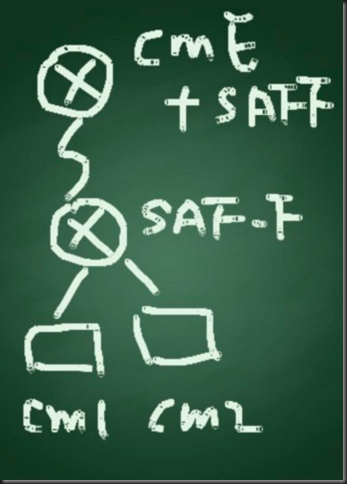
Image(1)

SAF Forwarder Configuration (for both UCM clusters)

SAF1#sh run

Building configuration...
Current configuration : 1958 bytes
!
! Last configuration change at 19:18:45 HKT Fri Mar 23 2012
version 15.2
service timestamps debug datetime msec
service timestamps log datetime msec
no service password-encryption
!
hostname SAF1
!
boot-start-marker
boot-end-marker
!
!
enable password cisco
!
no aaa new-model
clock timezone HKT 8 0
mmi polling-interval 60
no mmi auto-configure
no mmi pvc
mmi snmp-timeout 180
!
!
!
!
!
ip cef
no ipv6 cef
multilink bundle-name authenticated
!
!
!
!
!
!
!
username cisco
!
!
!
!
!
!
interface Ethernet0/0
no ip address
shutdown
!
interface Ethernet0/1
no ip address
shutdown
!
interface Ethernet0/2
no ip address
shutdown
!
interface Ethernet0/3
no ip address
shutdown
!
interface Ethernet1/0
no ip address
shutdown
!
interface Ethernet1/1
ip address dhcp
!
interface Ethernet1/2
no ip address
shutdown
!
interface Ethernet1/3
no ip address
shutdown
!
interface Serial2/0
no ip address
shutdown
serial restart-delay 0
!
interface Serial2/1
no ip address
shutdown
serial restart-delay 0
!
interface Serial2/2
no ip address
shutdown
serial restart-delay 0
!
interface Serial2/3
no ip address
shutdown
serial restart-delay 0
!
interface Serial3/0
no ip address
shutdown
serial restart-delay 0
!
interface Serial3/1
ip address 10.20.1.1 255.255.255.252
serial restart-delay 0
!
interface Serial3/2
no ip address
shutdown
serial restart-delay 0
!
interface Serial3/3
no ip address
shutdown
serial restart-delay 0
!
!
router eigrp SAFTEST
!
service-family ipv4 autonomous-system 1
  !
  topology base
  exit-sf-topology
exit-service-family
!
router ospf 1
network 0.0.0.0 255.255.255.255 area 0
!
ip forward-protocol nd
!
no ip http server
!
service-routing xmcp listen ipv4
client username safuser password 0 safpassword
  domain 1 default
!
!
!
!
!
mgcp profile default
!
!
!
!
voice service saf
!
!
!
line con 0
privilege level 15
logging synchronous
line aux 0
line vty 0 4
login
transport input all
!
!
end

Show command

SAF1#  show service-routing xmcp server
XMCP Server listening on port 4788
  Socket descriptors: 0 (TCP/IPv4)
  Connected clients: 0 unauthenticated, 2 total
  Maximum clients: unlimited
  Allow-lists: <none>
  Clients configured:
    Username "safuser", 2 client(s) connected

SAF1#  show service-routing xmcp client
Service-Routing XMCP Clients
Codes: A - Authenticated, T - TCP
    Handle     Address                                    Port  Keepalive
AT  3          192.168.90.223                            34220    22/30
    Client name: UCM/CM_cm86/NodeId=1/8.6.1.20000-1
AT  4          192.168.90.201                            60342    16/30
    Client name: UCM/192.168.90.201/NodeId=1/8.5.1.10000-26

SAF1#  show service-routing database
Service-Routing Database
Service ID (Service:Subservice:Instance)         Trust     Domain Owner Size
------------------------------------------------ --------- ------ ----- -----
      100:1:31000000-0000-0000-0000-000000000000 Connected *      1       319
      100:2:31000000-0000-0000-0000-000000000000 Connected *      1      1086
      101:2:275952D8-C2F9-38A8-AE06-8CE5000160D1 Connected 1      3       665
      101:2:733EF17C-84BD-5610-0325-D23200019F2E Connected 1      4       676

UCM Configuration

SAF Security Profile

Image(2)

SAF Forwarder (Client Label = username in new XCMP configuration)

Image(3)

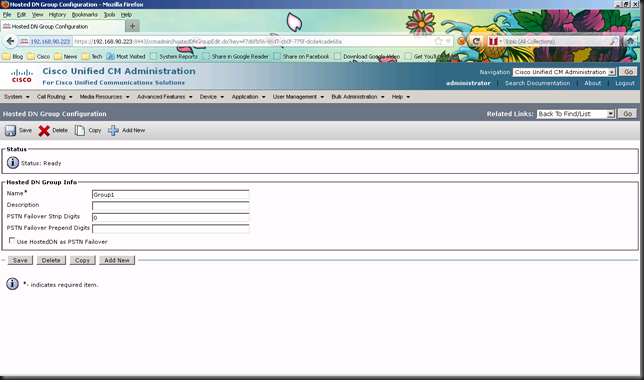
Hosted DN Group

Image(4)

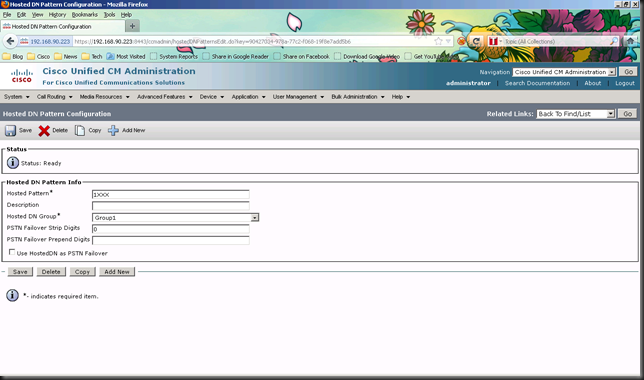
Hosted DN Pattern

Image(5)

Advertising Service

Image(6)

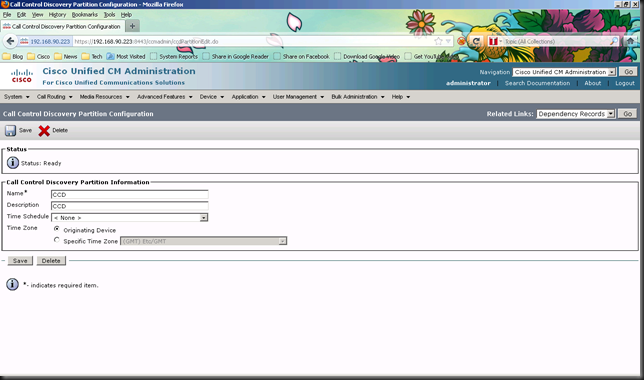
CCD Partition

Image(7)

Requesting Service

Image(8)

SAF Trunk

Image(9)

RTMT – The learnt dial plan is shown in RTMT

Image(10)

Then let’s move on to see the CME + SAF Forwarder configuration

CME + SAF Forwarder + SAF Client config

Current configuration : 2508 bytes
!
! Last configuration change at 20:42:48 HKT Fri Mar 23 2012
version 15.2
service timestamps debug datetime msec
service timestamps log datetime msec
no service password-encryption
!
hostname SAF2
!
boot-start-marker
boot-end-marker
!
!
!
no aaa new-model
clock timezone HKT 8 0
mmi polling-interval 60
no mmi auto-configure
no mmi pvc
mmi snmp-timeout 180
!
!
!
!
!
ip cef
no ipv6 cef
multilink bundle-name authenticated
!
!
!
!
!
!
!
!
!
!
!
!
!
interface Loopback0
ip address 10.20.30.1 255.255.255.255
!
interface Ethernet0/0
no ip address
shutdown
!
interface Ethernet0/1
no ip address
shutdown
!
interface Ethernet0/2
no ip address
shutdown
!
interface Ethernet0/3
no ip address
shutdown
!
interface Ethernet1/0
no ip address
shutdown
!
interface Ethernet1/1
no ip address
shutdown
!
interface Ethernet1/2
no ip address
shutdown
!
interface Ethernet1/3
no ip address
shutdown
!
interface Serial2/0
no ip address
shutdown
serial restart-delay 0
!
interface Serial2/1
no ip address
shutdown
serial restart-delay 0
!
interface Serial2/2
no ip address
shutdown
serial restart-delay 0
!
interface Serial2/3
no ip address
shutdown
serial restart-delay 0
!
interface Serial3/0
no ip address
shutdown
serial restart-delay 0
!
interface Serial3/1
ip address 10.20.1.2 255.255.255.252
serial restart-delay 0
!
interface Serial3/2
no ip address
shutdown
serial restart-delay 0
!
interface Serial3/3
no ip address
shutdown
serial restart-delay 0
!
!
router eigrp SAFTEST
!
service-family ipv4 autonomous-system 1
  !
  topology base
  exit-sf-topology
exit-service-family
!

router ospf 1
network 0.0.0.0 255.255.255.255 area 0
!

ip forward-protocol nd
!
no ip http server
!
!
!
!
!

!
dial-peer voice 1000 voip
destination-pattern ^1...$
session target saf
!
dial-peer voice 2000 voip
destination-pattern ^2...$
session target saf
!
mgcp profile default
!
!
!
!
voice service saf
profile trunk-route 1
  session protocol h323 interface Loopback0 transport tcp port 1720
  session protocol sip interface Loopback0 transport udp port 5060
!
profile dn-block 1
  pattern 1 type extension 3xxx
!
profile callcontrol 1
  dn-service name test
   trunk-route 1
   dn-block 1
  !
!
call
  timer aar-ageout 15
  pattern prefix
  !
!
channel 1 vrouter SAFTEST asystem 1
  subscribe callcontrol wildcarded
  publish callcontrol 1
!
!
!
telephony-service
max-ephones 30
max-dn 30
ip source-address 10.20.30.1 port 2000
max-conferences 4 gain -6
transfer-system full-consult
!
!
ephone-dn  1
number 3001
!
!
ephone  1
mac-address AABB.CCDD.EEFF
type 7965
button  1:1
!
!
!
line con 0
logging synchronous
line aux 0
line vty 0 4
login
transport input all
!
!
end

RTMT – See the learnt DNs from CME

Image(12)

Enable Root Access for EX60 / 90

To enable EX60 / 90 linux kernel with root access, you can first access the unit using the admin user right from a SSH client:

[root@panda ~]# ssh -l admin 192.168.10.1
Welcome to
TANDBERG Codec Release TC5.0.1.275220
SW Release Date: 2011-12-19

OK

systemtool rootsettings get


off


OK


systemtool rootsettings on


OK

Then you can access the unit with root access:

[root@panda ~]# ssh -l root 192.168.10.1
[tandberg:~] $

Friday, March 9, 2012

Ask the cloud

This is something I have created around 1.5 years ago.  Just found this video on my hard drive when I tried to free up some space of my hard drive.  This is a demonstration on how to control Cisco UCS Manager using voice recognition technology.

Cisco UCM + UCCX + VXML + DMS + UCS Manager + Nuance

At that time there is no Siri, yet, LOL


Sunday, February 26, 2012

MGCP Gateway Fallback Configuration Example

When you are deploying MGCP in branch office and the WAN connection between the MGCP gateway and UCM is broken, you can enable fallback on IOS gateway and route call based on your H.323 configuration.

These are the commands that you need to configure on your MGCP gateway.

R1(config)#ccm-manager fallback-mgcp


R1(config)#application
R1(config-app)#global
R1(config-app-global)#service alternate Default


Also configure the necessary incoming and outgoing voip and pots dial-peer as well as SRST configuration to handle the fallback situation.

VoiceView Express - Authentication Error

If you try to setup VoiceView Express for a CUE + UCM integration, and get the error:

Playback failed
Authentication error.  Report this error to your system administrator.

when you try to playback a message on Voiceview express, very likely you don't have the JTAPI user associated with the phone that use this service.  Make sure the JTAPI user is associated to the phones that are configured to use VoiceView Express.

Cisco UCM - Voice Mail Box Mask on Voice Mail Profile


The mask only mask the ReDir number.  Not the caller number, therefore:

When branch phone 5002 calls 5001 redir to 1220 (VM Pilot number, CUC in hub site) in SRST mode, it will mask the redir number from 98765001 (DID number) to 5001, therefore the caller 5002 can hear 5001's greeting instead of a general mailbox greeting.

However when 5001 press the voicemail envelop button on phone, the CLID is 98765001 therefore user 5001 doesn't able to listen to his personal greeting, as CUC doesn't recognize a subscriber has 98765001. It is not handled by the voice mail box mask.

One of the way is to enter 98765001 as alternate extension for the subscriber 5001.  If alternate extension is not a solution, you can use calling party transformation on UCM to manipulate the calling number, say for example create a new device pool for the voice mail ports on UCM and apply the calling party transformation CSS to this new device pool.

Cisco B-ACD on CME router - Drop-through option

In Cisco CME B-ACD, drop-through option can be configured so that when the AA services receive the incoming call, it will send the call directly to the call queue without provide menu options to callers.  This is useful for some small contact center backup, when the WAN link is downed and the site can't reach the contact center express or enterprise in the main site, it can still provide basic ACD service to the callers.

My Sample Configuration:


application
service aa flash:app-b-acd-aa-3.0.0.2.tcl
  paramspace english index 0
  param number-of-hunt-grps 1
  param drop-through-option 1
  param handoff-string aa
  paramspace english language en
  param max-time-vm-retry 2
  param aa-pilot 5000
  paramspace english location flash:
  param second-greeting-time 60
  param drop-through-prompt _dt_prompt.au
  param call-retry-timer 15
  param voice-mail 5555
  param max-time-call-retry 700
  param service-name callq
!
service callq flash:app-b-acd-3.0.0.2.tcl
  param queue-len 10
  param aa-hunt1 5600
  param queue-manager-debugs 1
  param number-of-hunt-grps 1


dial-peer voice 5000 pots
service aa
incoming called-number 5000

ephone-hunt 1 longest-idle
pilot 5600
list 5111, 5112

When there is incoming call, on both of the phone with ephone-dn 5111 and 5112, the message "1 call in queue" will be shown on the phone screen and you will know how many callers waiting in the call queue.


For more information:
http://www.cisco.com/en/US/docs/voice_ip_comm/cucme/bacd/configuration/guide/40bacd.html